
Signs of Professional Turf Installation in Darwin
Quality Garden Services NT - Your trusted partner in creating lush, thriving outdoor spaces in the Northern Territory.
In Darwin’s challenging tropical climate, the difference between a lush, resilient lawn and a patchy, weed-infested mess comes down to the quality of turf installation. Professional turf installation is a multi-step process that addresses soil, drainage, weed management, and turf selection—ensuring your lawn thrives through the wet and dry seasons.
Introduction: Why Turf Installation in Darwin Is Unique
Living and working in Darwin, Palmerston and Humpty Doo, Northern Territory, I’ve seen firsthand how our tropical climate can make or break a lawn. With a wet season stretching from November to April, dumping an average of 1,727 mm of rain and humidity often exceeding 80%, Darwin’s environment is both a blessing and a challenge for turf and garden lovers. Our soils range from heavy clays that hold water to sandy loams that drain too quickly. These extremes mean that a “one-size-fits-all” approach to turf simply doesn’t work here.
Every year, especially after the long wet season, I get calls from frustrated homeowners and property managers whose lawns have turned into bogs, weed patches, or uneven, spongy messes.
The culprit?
Cheap or non-professional turf installation that failed to account for Darwin’s unique conditions. In this post, I’ll walk you through what sets professional turf installation apart, the telltale signs of a job done right (and wrong), and my own recommendations for a lawn that will thrive year after year.
What Does Professional Turf Installation in Darwin Include?
1. Soil Preparation: The Foundation of a Healthy Lawn
a. Soil pH Testing and Amendment
Why it matters: Darwin’s soils can be acidic, alkaline, or somewhere in between. Turf thrives best in a pH range of 5.5 to 7.0.
Professional approach: We collect soil samples from multiple spots at a depth of 100–150 mm and test the pH. If the soil is too acidic, we add lime; if too alkaline, we use sulphur to adjust.
b. Amending Soil Structure
Clay soils: Common in Darwin, these need de-compacting and the addition of gypsum to break up the clay, plus sand and organic matter for structure and drainage.
Sandy soils: We add organic matter to improve water and nutrient retention.
Topsoil depth: A minimum of 100 mm, ideally 100–150 mm, of quality turf underlay is essential for root development and drainage.
c. Adding Organic Matter
How much: 20–30 mm of compost or manure is incorporated into the topsoil.
Benefits: Boosts fertility, improves moisture retention, and supports rapid turf establishment.
2. Ground Levelling and Grading: Creating a Smooth, Functional Surface
Levelling: After soil prep, we use rakes, screeds, and rollers to create a smooth, even surface. For lawns flush with paths or driveways, the soil is set 30–40 mm below the final height to allow for turf thickness.
Grading for runoff: A gentle slope of 1–2% (10–20 mm per metre) is created to direct water away from buildings and prevent pooling.
3. Drainage Solutions: Preventing Waterlogging and Turf Failure
a. Subsurface Drainage
Ag pipes: Installed 300–400 mm below the surface in areas prone to waterlogging, these pipes help move excess water away from the root zone.
b. French Drains
Construction: Gravel-filled trenches with perforated pipes intercept and redirect water, ideal for heavy clay soils or persistent wet spots.
c. Drainage Gradients
Best practice: Maintain a minimum gradient of 1–2% away from structures to ensure surface water drains efficiently.
4. Comprehensive Weed Management: Starting Clean, Staying Clean
a. Pre-Installation
Herbicide application: We use a non-selective herbicide (like glyphosate) to kill existing weeds, often requiring two applications for stubborn species.
Scalping: Removing dead vegetation and scalping the area to soil level eliminates weed seeds and debris.
Soil sterilisation: In high-weed areas, we may use soil solarisation or chemical sterilisation for extra control.
b. Post-Installation
Monitoring: Regular inspections and spot-treatments with selective herbicides keep weeds at bay.
Cultural practices: Dense, healthy turf is the best defence against weed invasion.
5. Turf Establishment Care: Setting Up for Success
Watering: Immediately after laying, we water thoroughly. For the first three weeks, daily watering (sometimes 2–3 times per day in hot weather) is essential. After three weeks, we reduce to every 2–3 days, depending on conditions.
Fertilisation: A starter fertiliser is applied at installation to promote root growth, followed by balanced fertilisers as needed.
Mowing: The first mow happens after 3–4 weeks, once the turf is firmly rooted. We use sharp blades and never remove more than one-third of the leaf blade per mow.
Installation Techniques: Matching the Method to the Site
1. Roll-On Turf (Instant Turf)
How it’s done: Rolls or slabs of turf are laid tightly together, with joins staggered in a brickwork pattern to prevent erosion and gaps.
Perimeter first: We start with the edges, then fill in the centre.
Rolling: A roller is used to ensure good root-soil contact and a smooth finish.
Watering: Each section is watered as it’s laid, especially in hot weather.
2. Hydro-Seeding
What it is: A slurry of seed, mulch, and fertiliser is sprayed onto prepared soil.
Best for: Large or sloped areas where roll-on turf isn’t practical.
3. Sprigging
How it works: Small pieces of turf (sprigs) are planted directly into the soil.
Best for: Certain varieties like Zoysia and Couch, and large-scale projects. It’s slower to establish than roll-on turf but cost-effective for big areas.
Turf Varieties Suited to Darwin’s Tropical Climate
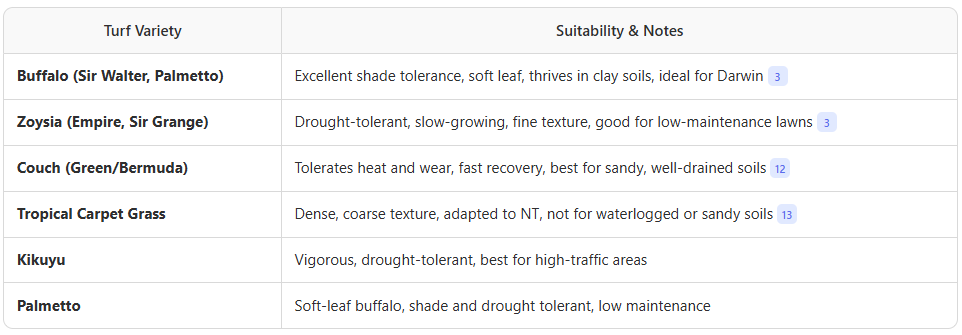
Key Finding:
Choosing the right turf variety for your specific soil and site conditions is critical for long-term success in Darwin’s climate.
Signs of a Professionally Installed Lawn in Darwin
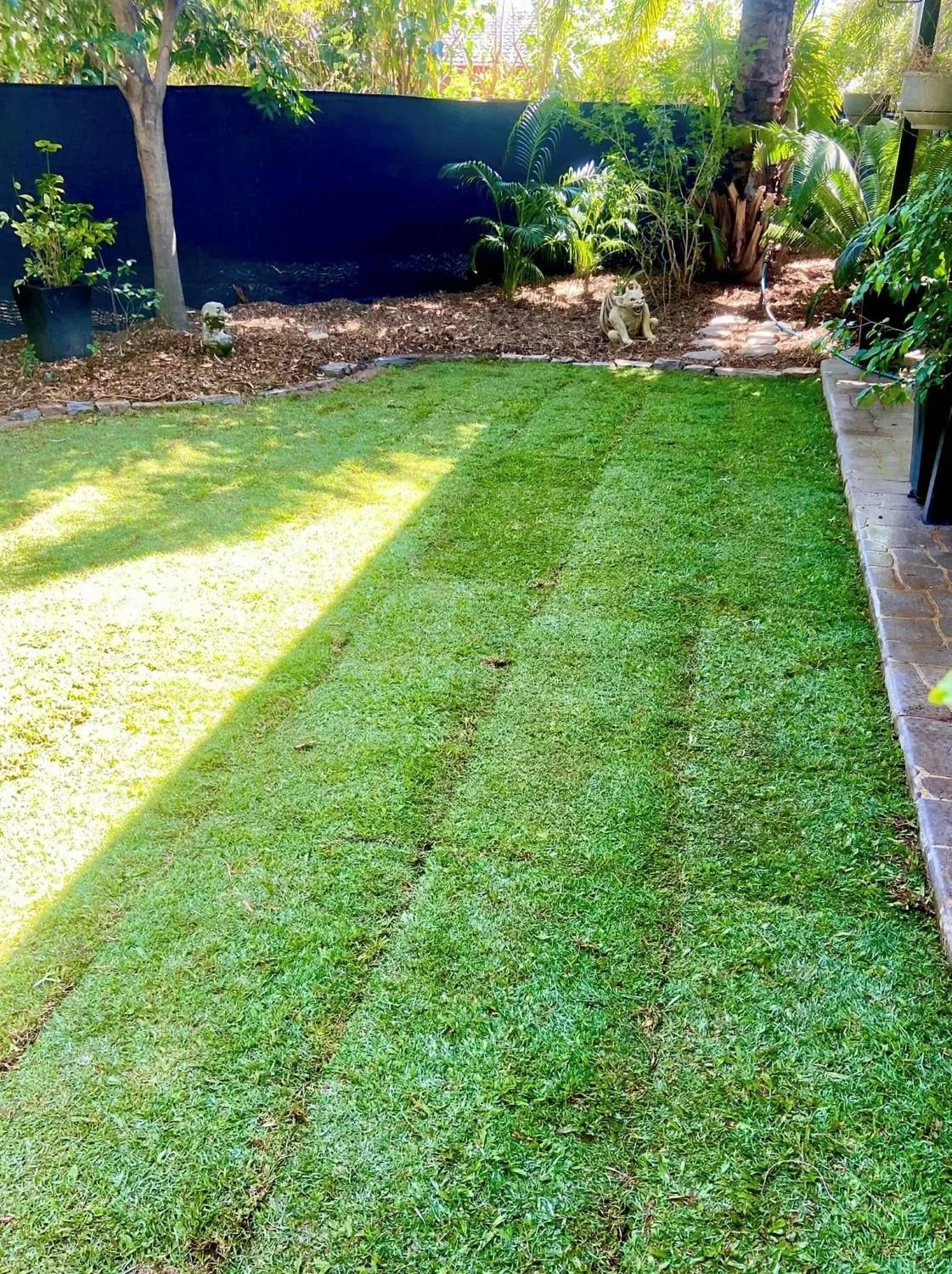
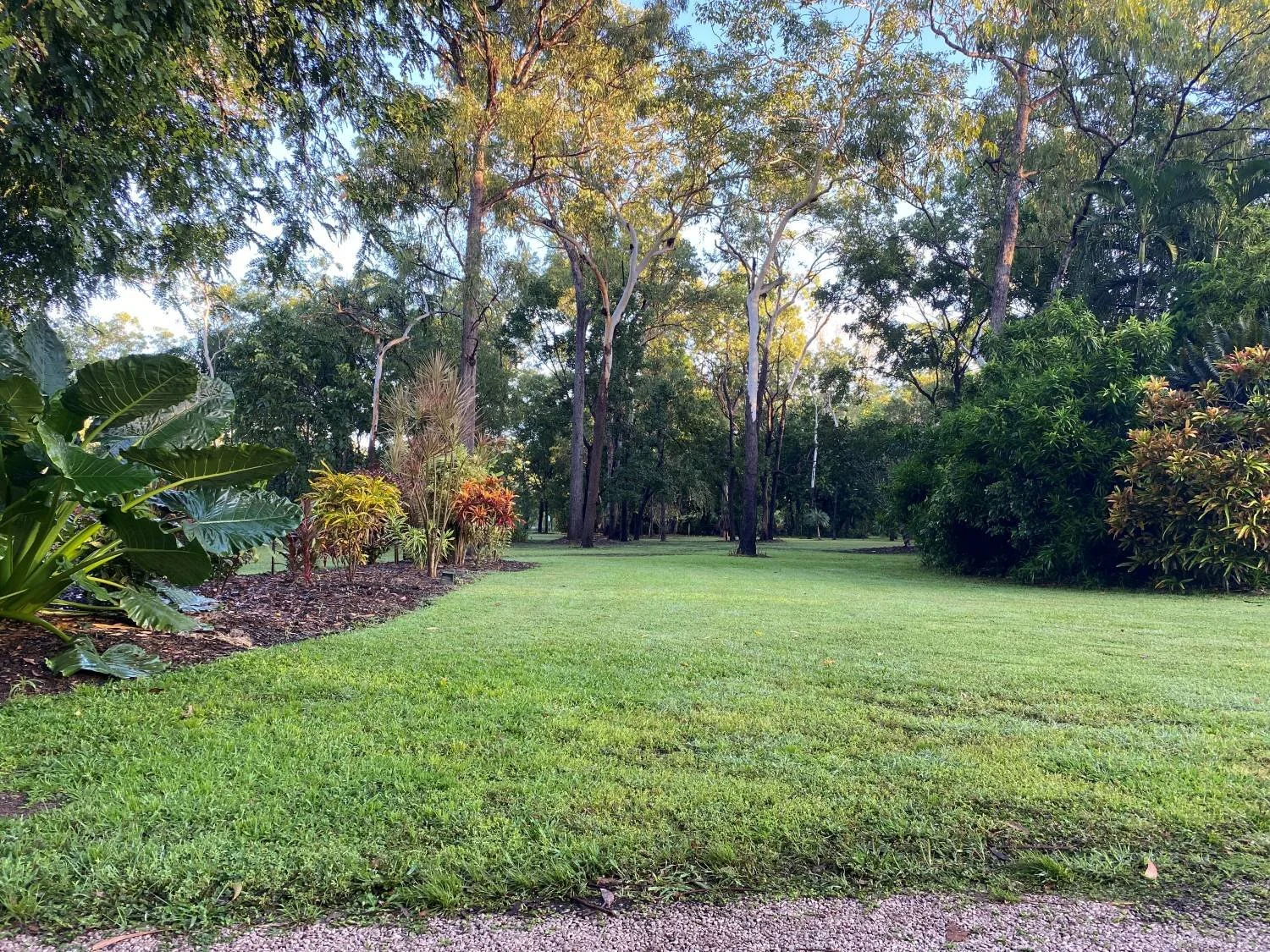
A professionally installed lawn stands out—especially after the wet season.
Here’s what to look for:
1. Smooth, Even Surface
What you see: The lawn is level, with no bumps, hollows, or uneven patches.
Why it matters: Proper levelling prevents water pooling and makes mowing easier.
2. Tight, Invisible Joins Between Turf Rolls
What you see: Turf rolls are laid tightly together, with no visible gaps or seams.
Why it matters: Tight joins prevent weed invasion and create a seamless, carpet-like appearance.
3. Healthy, Consistent Colour
What you see: The lawn is a uniform, vibrant green, with no yellow or brown patches.
Why it matters: Consistent colour indicates healthy turf, good soil preparation, and proper fertilisation.
4. No Pooling Water or Waterlogged Areas
What you see: After rain, water drains away quickly, and the lawn dries evenly.
Why it matters: Good drainage prevents root rot, fungal diseases, and turf die-off.
5. Firm, Stable Footing
What you feel: The turf feels solid underfoot, not spongy or loose.
Why it matters: Firm footing means the turf is well-rooted and the soil is properly prepared.
6. Minimal Weed Presence
What you see: Few, if any, weeds are visible, even after the wet season.
Why it matters: Effective pre-installation weed management and healthy turf density keep weeds at bay.
Common Signs of Turf Installed by Non-Professionals or the Cheap Way
Unfortunately, I see these issues all too often in Darwin, especially after the wet season:
1. Uneven, Bumpy Surfaces
Symptoms: The lawn is lumpy, with hollows and high spots.
Cause: Inadequate levelling and poor soil preparation.
2. Visible Gaps or Seams Between Turf Rolls
Symptoms: Gaps between rolls, sometimes widening after rain.
Cause: Turf not laid tightly or not staggered properly.
3. Shallow Root Establishment (Spongy or Floating Turf)
Symptoms: Turf lifts easily, feels spongy, or even floats after heavy rain.
Cause: Poor soil-turf integration, insufficient watering during establishment.
4. Wrong Turf Variety Chosen
Symptoms: Turf struggles, turns yellow, or dies off in patches.
Cause: Using varieties unsuited to Darwin’s climate or soil type.
5. Pooling and Waterlogged Areas
Symptoms: Persistent puddles or boggy patches after rain.
Cause: No drainage planning or soil amendment.
6. Rapid Weed Invasion
Symptoms: Nutgrass, paspalum, and broadleaf weeds quickly take over.
Cause: Incomplete weed eradication before turfing, poor turf density.
7. Erosion on Slopes
Symptoms: Bare patches, exposed roots, or turf washed away.
Cause: No erosion control measures, poor anchoring on slopes.
8. Soil Compaction
Symptoms: Hard, compacted areas where turf struggles to grow.
Cause: No soil de-compaction or amendment before turfing.
9. Patchy Die-Off and Colour Variations
Symptoms: Yellow or brown patches, inconsistent growth.
Cause: Uneven soil preparation, poor drainage, or wrong turf variety.
Why Darwin’s Wet Season Reveals Cheap or Substandard Turf Installation
The wet season in Darwin is the ultimate test for any lawn.
Here’s why:
1. Drainage Failures Become Obvious
What happens: Heavy, sustained rains quickly expose areas where water can’t drain, leading to waterlogged turf and root rot.
2. Turf Lifting and Floating
What happens: Turf that wasn’t properly integrated with the soil or anchored on slopes can lift or float away during storms.
3. Accelerated Weed Invasion
What happens: Warm, wet conditions are perfect for weed seeds to germinate, especially in disturbed or poorly prepared soils.
4. Erosion and Washout
What happens: Intense rainfall and runoff strip away soil and turf on slopes or unlevelled ground.
5. Compacted Clay Turns to Bog
What happens: Areas with compacted clay soil become boggy and suffocate turf roots, leading to die-off.
Key Takeaway:
The wet season acts as a “stress test” for your lawn. If corners were cut during installation, the problems will show up—often dramatically—after months of heavy rain.
Real-World Examples: Darwin Lawns After the Wet Season
Case 1: A homeowner in Nightcliff called after their new lawn turned into a swampy mess. The installer had skipped soil amendment and drainage planning. After the wet season, half the turf had died, and nutgrass had taken over.
Case 2: A property manager in Palmerston noticed turf lifting and floating after storms. Investigation revealed the turf was laid on compacted clay with no integration or rolling.
Case 3: A business in Winnellie had patchy, yellowing turf and persistent puddles. The wrong turf variety was used for the site’s heavy clay soil, and no grading was done for runoff.
My Recommendations for a Resilient, Beautiful Lawn in Darwin
1. Time Your Turf Installation for the Dry Season
Why: Turf establishes best when it’s not battling heavy rain and waterlogging. May to October is ideal.
2. Invest in Professional Drainage Assessment
Why: Proper drainage is non-negotiable in Darwin. A small investment upfront saves major headaches later.
3. Don’t Cut Corners on Soil Preparation
Why: The most common cause of turf failure is poor soil prep. Quality underlay, organic matter, and pH adjustment are worth every cent.
4. Choose the Right Turf Variety for Your Site
Why: Not all turf is created equal. Match the variety to your soil, shade, and usage needs.
5. Follow Post-Installation Care Instructions
Why: Watering, fertilising, and mowing schedules are critical for establishment. Don’t neglect them.
6. Schedule a Professional Lawn Health Check Before the Wet Season
Why: Catching drainage or weed issues early can prevent major problems during the wet.
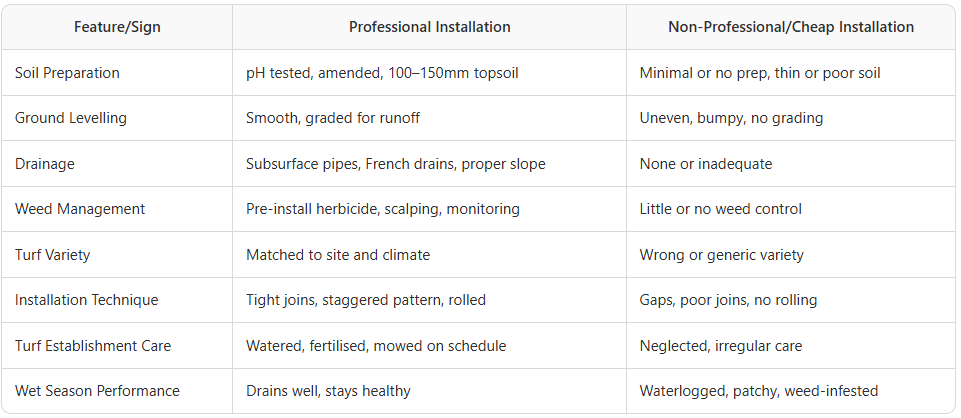
Summary Table: Professional vs. Non-Professional Turf Installation
Conclusion: Invest in Professional Turf Installation for Lasting Results
Darwin’s climate is both beautiful and brutal for lawns. The wet season exposes every shortcut and mistake made during turf installation. That’s why professional turf installation—done with local knowledge, the right techniques, and attention to detail—isn’t just a luxury, it’s a necessity.
If you want a lawn that stays green, healthy, and weed-free year after year, don’t settle for the cheapest quote. Invest in proper soil preparation, drainage, and turf selection. Work with professionals who understand Darwin’s unique challenges. And remember: the best time to fix a lawn is before the wet season starts.
Don’t leave your lawn’s recovery to chance.
Book a professional lawn assessment with our local team today and give your turf the expert care it deserves.
Contact us now for a healthier, greener, and more resilient lawn—ready to thrive in Darwin’s dry season and beyond!
About Us
At Quality Garden Services NT, we’re passionate about healthy soils and vibrant landscapes in Darwin. From turf management and grounds maintenance to garden renovations and soil health advice, our expert team is here to help you achieve your green goals—no matter the season.
If you’re in Darwin, Palmerston, Humpty Doo or the rural areas and looking for reliable, trusted garden & grounds maintenance services, look no further than Quality Garden Services NT.
We specialize in turf management, grounds maintenance, and garden care in Darwin and the Northern Territory.
Contact us today (0498649535) to learn more about how wetting agents can transform your lawn!
At Quality Garden Services NT, we understand how important it is to maintain a lush, healthy lawn and vibrant garden in Darwin’s unique climate.
Why Choose Us?
Choosing the right grounds maintenance and gardening service is crucial for the health and appearance of your property. Here’s why we stand out:
Local Expertise: Our team is familiar with the unique climate and soil conditions of the Darwin, Palmerston, Humpty Doo and surrounding areas. We know what works best for your gardens and lawns.
Quality Service: We are committed to delivering high-quality work. Our goal is to exceed your expectations, leaving you with well-maintained outdoor spaces.
Customer Satisfaction: Your satisfaction is our priority. We take the time to listen to your needs and tailor our services accordingly - be it for commercial or private properties.
Thank you for visiting our website!