
Mown Areas, Managed Areas and Natural Areas: Finding the Right Balance on Acreage around Darwin
Quality Garden Services NT - Your trusted partner in creating lush, thriving outdoor spaces in the Northern Territory.
Managing acreage in Darwin’s Top End is all about balance—between lush lawns, productive gardens, and the wild beauty of native bush. With our unique tropical climate, strict weed and fire regulations, and the sheer scale of rural blocks, getting this balance right is both a challenge and a joy. In this guide, we share our local expertise to help you create a property that’s safe, sustainable, and a pleasure to live on.

Introduction: The Acreage Challenge in the Top End
If you own or manage acreage around Darwin—whether it’s in Humpty Doo, Howard Springs, Bees Creek, Lambells Lagoon, or Darwin River—you know that living on a rural block in the Top End is a lifestyle like no other. Our properties are big (typically 1 to 8 hectares, or 2.5 to 20 acres), our climate is dramatic, and our land is a patchwork of lawns, gardens, and bushland.
The 2025–26 wet season was a real standout, with Darwin Airport recording rainfall at around 144% of the long-term average—over 2,397mm for the year. That means explosive growth, boggy soils, and a maintenance calendar that never seems to let up.
But with the right approach, you can turn these challenges into opportunities.
The secret? Understanding and managing your property in three distinct zones:
Mown Areas: The lawns and high-use spaces that frame your home and lifestyle.
Managed Areas: The productive, designed transition zones—think gardens, orchards, and bush tucker plantings.
Natural Areas: The wild bushland that makes the Top End special, managed for both conservation and safety.
Let’s dive into how to find the right balance for your block.
Understanding the Top End Property Landscape
The Tropical Climate: Wet, Dry, and Everything In Between
Darwin and the Top End operate on a rhythm all their own, with three distinct seasons:
Dry Season (May–September):
Warm, sunny days, low humidity, and barely a drop of rain (about 20mm per month). This is when most major property works get done—firebreaks, landscaping, and upgrades.
Build-Up (October–November):
The heat and humidity ramp up, but rain is still scarce. Plants, people, and animals all feel the pressure. Early storms can bring sudden flushes of growth and debris.
Wet Season (December–April):
The monsoon arrives, bringing intense storms, high humidity (81–83% at 9am), and rapid, almost uncontrollable growth. Lawns and weeds explode, access to low-lying areas can be cut off, and cyclone prep is a must.
Key BOM Data for Darwin (2025–26):

What This Means for Acreage Management
Wet Season:
Expect weekly mowing, slashing, and weed control. Access can be tricky in boggy areas. Storms and cyclones mean regular clean-up and drainage checks.
Build-Up:
Get on top of mowing and weed management before the rains hit. Service your equipment and clear debris.
Dry Season:
Growth slows, making it the best time for major works—firebreaks, pruning, irrigation upgrades, and garden installations.
Seasonal Maintenance Calendar:

Mown Areas — Getting Your Turf Right in the Tropics
Choosing the Right Turf for Darwin
Not all grasses are created equal—especially in the Top End.
Here’s what works best on our rural blocks:
1. Buffalo Grass (Sir Walter, Palmetto)
Why We Love It:
Excellent shade and heat tolerance, handles 3–4 hours of direct sunlight, good salt tolerance (great for coastal or saline-prone areas), and forms a dense, robust mat.Mowing:
Wet season: 20–40mm
Dry season: 40–60mm
Frequency: 1–2 times/week in the wet, 1–2 times/month in the dry
Other Benefits:
Recovers well from wear, resists most pests and diseases, and is less prone to scalping.
2. Zoysia Grass (Empire, Nara, Sir Grange)
Why We Love It:
Dense, slow-growing, moderate shade tolerance, and can be left unmown for a textured, natural look in low-traffic areas.Mowing:
Wet season: 5–30mm
Dry season: 30–50mm
Frequency: 1–2 times/week in the wet, 1–2 times/month in the dry
Other Benefits:
Lower maintenance, good drought resistance, but slower to recover from heavy wear.
3. Couch Grass (Wintergreen, Legend, TifTuf Hybrid Bermuda)
Why We Love It:
Thrives in full sun, perfect for high-traffic areas (driveways, sports zones), and recovers quickly from damage.
Mowing:
Wet season: 4–20mm
Dry season: 20–36mm
Frequency: 2–3 times/week in the wet, 1–2 times/month in the dry
Other Benefits:
Needs at least 5–6 hours of direct sun; not suitable for shaded spots.
4. Carpet Grass and Blue Couch
Why We Love Them:
Good for lower-maintenance or less trafficked areas. Carpet grass is coarse-leaved and slow to recover from wear; blue couch offers good colour and density but is less drought and disease resistant.
Performance Comparison Table:

Best-Practice Mowing and Turf Management
The One-Third Rule:
Never remove more than one-third of the leaf blade in a single mow. This keeps your turf healthy and reduces stress.
Fertilising:
Use slow-release NPK granules three times per year (spring, summer, autumn).
Avoid excess nitrogen in the peak wet season—it can cause rapid, weak growth and more mowing.
Watering:
In the wet season, irrigation is rarely needed.
In the dry, water deeply once or twice a week to encourage deep roots.
For large rural properties, efficient irrigation systems (pop-up sprinklers, drip lines) are best.
Note: If you’re using bore water or irrigating large areas, you may need a water extraction licence under NT regulations.
Common Problems and Solutions:
Armyworms/Lawn Grubs:
Watch for patchy dieback or birds feeding on the lawn. Use Acelepryn GR or Grub Guard for control.Fungal Disease:
Water in the morning, improve drainage, and avoid overwatering.Nutgrass and Broadleaf Weeds:
Keep turf dense and healthy. Use herbicides appropriate for your turf type (never use Dicamba/DSMA on buffalo; bromoxynil-based products are safe).
Sizing and Zoning Your Mown Areas
Not every hectare needs to be lawn! Focus your mown areas around the house, entertaining spaces, and high-use zones. For most properties, this means:
Immediate Living Zone:
Lawns for play, pets, and outdoor living.Driveways and Access:
Mown strips for safe vehicle and pedestrian movement.Firebreaks:
Mown or slashed areas to meet fire safety requirements.
Key Insight:
Over-extending your lawn means more mowing, more water, and higher costs. Smart zoning saves time and money.
Managed Areas — The Productive Middle Ground
What Are Managed Areas?
Managed areas are the “in-between” zones—designed, planted, and maintained, but not as intensively as your main lawn. Think of them as the buffer between your house and the wild bush: gardens, orchards, bush tucker plantings, and shade trees.
Design Principles for Managed Areas
Layered Planting:
Combine groundcovers, shrubs, and canopy trees for habitat value and visual interest.Native and Climate-Adapted Species:
Choose plants that thrive in Darwin’s wet-dry tropics for resilience and low water needs.Bush Tucker and Edible Gardens:
Incorporate native food plants for both productivity and cultural value.Shade Trees:
Provide cooling, reduce evaporation, and create wildlife habitat.Mulching and Soil Improvement:
Use organic matter and mulch to boost fertility, retain moisture, and suppress weeds.Water-Wise Irrigation:
Drip irrigation or soaker hoses, grouped by plant water needs.
Recommended Native Plant Palette
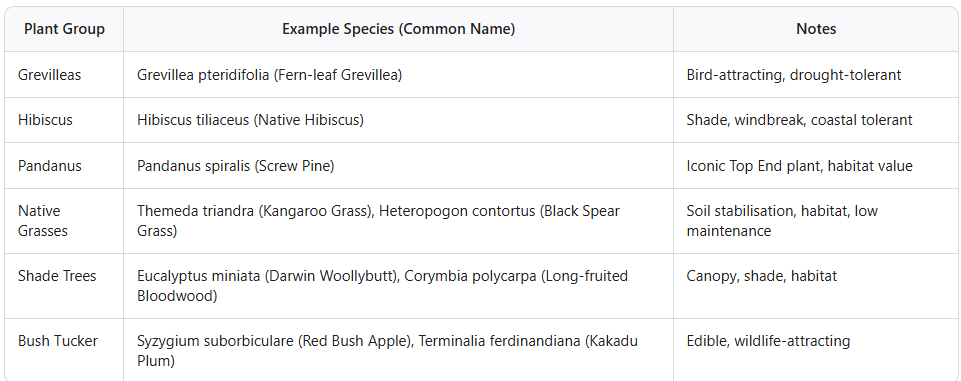
Soil Improvement and Mulching
Soil Quality:
Top End soils are often poor—add compost, well-rotted manure, and use slow-release, low-phosphorus native plant fertilisers.Mulching:
Apply coarse organic mulch (woodchip, leaf litter) to 5–10cm depth, replenished annually. This keeps roots cool, suppresses weeds, and conserves moisture.
Irrigation and Water-Wise Strategies
Establishment:
Water deeply once or twice a week during the dry season until plants are established.Maintenance:
Once established, most natives need little or no irrigation except in extreme dry spells.Timing:
Water early morning or late afternoon to reduce evaporation.Regulations:
Large-scale irrigation may require a water extraction licence under the NT Water Act 1992.
Bush Tucker Gardens
Popular Species:
Kakadu Plum (Terminalia ferdinandiana): High vitamin C, used in jams and sauces.
Red Bush Apple (Syzygium suborbiculare): Edible fruit, attracts wildlife.
Native yams (Dioscorea spp.): Edible tubers.
Maintenance:
Similar to other native plantings—focus on soil improvement, mulching, and water-wise irrigation.
Regulatory Considerations
Land Clearing:
Clearing native vegetation on freehold unzoned land is regulated under the Planning Act 1999 and NT Planning Scheme Land Clearing Guidelines.Permit required if clearing more than one hectare.
On parcels 100ha or more, up to 10ha can be cleared without a permit if no significant vegetation is present.
Applications require a clearing plan, spatial data, and review by the Native Vegetation Assessment Panel.
Local councils (Litchfield, Darwin) are consulted.
Water Extraction:
Irrigation for managed areas may require a licence under the Water Act 1992.Best Practice:
Always check before clearing or installing large-scale irrigation.
Key Finding:
Managed areas are your opportunity to create a beautiful, productive, and resilient landscape that bridges the gap between lawn and bush—while staying compliant with NT regulations.
Natural Areas — Your Bush as an Asset, Not a Liability
Why Retain Natural Bushland?
Natural bushland is more than just “the back paddock.” It’s a vital asset for your property and the wider Top End environment:
Wildlife Habitat:
Supports birds, wallabies, insects, and even fireflies.Ecosystem Services:
Provides pollination, carbon sequestration, water regulation, and soil health.Landscape Connectivity:
Maintains wildlife corridors as Darwin expands.Community Wellbeing:
Access to natural areas enhances quality of life and supports sustainable land management.
Land for Wildlife (LFW):
A voluntary program through Territory NRM that helps landholders manage parts of their property as wildlife habitat, offering advice on fire, weed, and feral animal management.
Major Threats to Natural Areas
1. Declared Weeds
The NT Weeds Management Act 2001 places legal obligations on all landholders to control declared weeds. The most critical threats include:

Gamba Grass (Andropogon gayanus):
Why It’s a Problem:
Creates extreme fuel loads, leading to uncontrollable, hot fires that burn much hotter than native grass fires—threatening people, property, and ecosystems.Legal Requirements:
In Class A zones, all gamba must be eradicated.
In Class B zones (>3ha), a 15m wide gamba-free buffer must be maintained around property boundaries, driveways, and infrastructure.
Annual reduction of gamba plants is required.
Free herbicide and equipment loans are available through the Gamba Action Program.
Report using the NT WeedMate App.
Non-compliance is an offence.
Other Problem Weeds:
Mission grass, Grader grass, Parkinsonia (dense thickets impacting waterways), Mimosa (invades wetlands, causes biodiversity loss), Candle bush.
2. Bushfire Risk
All rural landholders must establish and maintain firebreaks:

Permits to Burn:
Required during declared fire danger periods.Notification:
If a fire escapes, notify Bushfires NT and affected neighbours.Fire Protection Zones:
Properties within FPZs have additional responsibilities.Bushfire Management Plans:
Strongly encouraged—Bushfires NT can help.
3. Feral Animals and Other Threats
Feral Pigs, Cats, Cane Toads:
Threaten native wildlife and bushland integrity.Lantana:
Invasive in some areas, contributes to habitat degradation and increased fire risk.
The Value of Natural Areas
Wildlife:
Birds, wallabies, and insects depend on intact bushland.Ecosystem Services:
Pollination, soil health, water regulation, carbon sequestration.Landscape Connectivity:
Maintains wildlife corridors and reduces habitat fragmentation.Community Wellbeing:
Access to natural bush enhances quality of life.
Key Takeaway:
With the right management—weed control, firebreaks, and pest management—your bushland can be a safe, beautiful, and ecologically valuable part of your property.
Finding the Right Balance — A Practical Framework
The Three-Zone Approach
Every property is different, but a practical zoning approach can help you get the most from your land:
1) Immediate Living Zone (Mown Areas):
House, entertaining areas, play spaces.
Lawns for lifestyle and fire safety.
2) Transition Zone (Managed Areas):
20–50m ring of native gardens, bush tucker, and shade trees.
Designed for habitat, productivity, and reduced maintenance.
3) Outer Zone (Natural Areas):
Retain as much native bush as possible.
Maintain firebreaks, control weeds, and manage feral animals.
How the Balance Changes with Property Size:
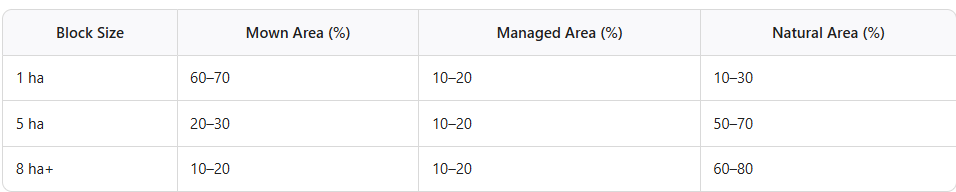
Seasonal Strategy
Dry Season:
Prime time for major works—firebreaks, garden installations, turf renovations, slashing, weed spraying, clearing permits, bore pump servicing.Wet Season:
Reactive management—frequent mowing, storm clean-up, drainage, weed monitoring.
The Benefits of Getting the Balance Right
Lower Long-Term Maintenance Costs:
Less mowing, less water, fewer inputs.Improved Property Resilience:
Better fire and flood management, healthier soils, and more robust landscapes.Wildlife and Ecosystem Health:
More habitat, more biodiversity, and a healthier environment.A More Enjoyable Property:
Spaces that work for you, your family, and the local wildlife.
Conclusion: Let’s Make Your Acreage Work for You
Managing acreage in Darwin’s Top End is a unique challenge—but it’s one we love. With the right balance of mown, managed, and natural areas, your property can be safe, sustainable, and a joy to live on.
At Quality Garden Services NT, we’re here to help. Whether you need mowing and slashing, garden design and installation, seasonal weed and pest management, firebreak slashing, or ongoing grounds maintenance, our local team has the expertise and equipment to get the job done.
If you’re in Darwin, Palmerston, Humpty Doo or the rural areas and looking for reliable, trusted garden & grounds maintenance services, look no further than Quality Garden Services NT.
We specialize in turf management, grounds maintenance, and garden care in Darwin and the Northern Territory.
Contact us today (0498649535) to learn more about how wetting agents can transform your lawn!
At Quality Garden Services NT, we understand how important it is to maintain a lush, healthy lawn and vibrant garden in Darwin’s unique climate.
Why Choose Us?
Choosing the right grounds maintenance and gardening service is crucial for the health and appearance of your property. Here’s why we stand out:
Local Expertise: Our team is familiar with the unique climate and soil conditions of the Darwin, Palmerston, Humpty Doo and surrounding areas. We know what works best for your gardens and lawns.
Quality Service: We are committed to delivering high-quality work. Our goal is to exceed your expectations, leaving you with well-maintained outdoor spaces.
Customer Satisfaction: Your satisfaction is our priority. We take the time to listen to your needs and tailor our services accordingly - be it for commercial or private properties.
Thank you for visiting our website!