
The Hidden Cost of Letting an Acreage Property Get Away From You
Quality Garden Services NT - Your trusted partner in creating lush, thriving outdoor spaces in the Northern Territory.
Letting your acreage property in Darwin’s rural area become overgrown isn’t just a matter of untidy lawns—it’s a recipe for spiraling costs, legal headaches, fire risk, health hazards, and lost property value. Regular, professional maintenance is not just an expense—it’s an investment in safety, compliance, and peace of mind.

Introduction: The Top End’s Acreage Challenge
Owning acreage in Darwin’s rural belt—places like Humpty Doo, Howard Springs, Berry Springs, Bees Creek, Virginia, and Girraween—is a dream for many. The space, the freedom, the bushland beauty. But as any local will tell you, the Top End’s climate doesn’t just nurture paradise—it can turn your slice of heaven into a wild, costly headache almost overnight.
As operators of a turf management and grounds maintenance business in Humpty Doo, we’ve seen firsthand what happens when acreage gets away from its owners. The “hidden cost” isn’t just about money—it’s about time, stress, legal risk, and even your family’s safety. In this post, we’ll break down exactly what’s at stake, why the Top End is uniquely challenging, and how you can stay ahead of the game.
1. The Top End’s Unique Climate: Why Acreage Grows Wild, Fast
The Wet Season Explosion
Darwin’s climate is legendary: hot, humid, and defined by dramatic seasonal swings. The Wet Season (roughly November to April) brings monsoonal rains, lightning storms, and humidity that can make your glasses fog up just stepping outside. For your acreage, this means one thing: explosive growth.
Grass and weeds can grow 10-20cm per week during peak wet season.
Areas like Humpty Doo and Howard Springs, with their fertile soils and high rainfall, are especially prone to rapid overgrowth.
Even if you slash or mow in late October, by Christmas your block can look like a jungle.
The Build-Up and Dry Season
The Build-Up (September–November) is hot and sticky, with storms threatening but not always delivering rain. Grasses start to surge.
The Dry Season (May–August) brings relief, but also dries out all that lush growth—turning it into prime fire fuel.
Local Insight:
“We’ve seen blocks in Berry Springs go from neat to knee-high in three weeks after a big rain. If you miss a mowing cycle, you’re playing catch-up for months.”
2. The Grass Problem: Gamba, Mission, and More
Gamba Grass: The Firestarter
Gamba grass (Andropogon gayanus) is an introduced species that can grow over 4m tall.
It’s a declared weed under NT law, and for good reason: it creates fuel loads up to 10 times higher than native grasses.
Fires in gamba-infested areas burn hotter, faster, and are much harder to control.
Mission Grass and Other Invaders
Mission grass (Cenchrus polystachios and C. pedicellatus) is another aggressive invader, forming dense stands that outcompete natives and fuel fires.
Para grass, couch, and buffalo grass are common pasture species. While useful for grazing, they can quickly become unmanageable if left unchecked.
Why It Matters:
Unchecked, these grasses don’t just look bad—they create a catastrophic fire risk for your property and your neighbours.
3. Legal Obligations: What the Law Says (and the Fines for Ignoring It)
Weeds Management Act 2001 (NT)
Duty to Control Declared Weeds:
Landholders must take “all reasonable measures” to prevent the spread of declared weeds like gamba and mission grass.Penalties:
Fines can exceed $15,000 for non-compliance, and repeat offenders may face prosecution.
Bushfires NT Firebreak Requirements
Firebreaks:
All rural properties must maintain a 4m-wide firebreak, cleared of flammable material, around the boundary and around structures.Inspections:
Bushfires NT conducts random and complaint-driven inspections, especially in high-risk areas like Virginia and Girraween.Penalties:
Non-compliance can result in fines, and in extreme cases, the government may arrange for works to be done at your expense.
Local Council By-Laws
Many councils (e.g., Litchfield, Palmerston) have additional requirements for grass height and weed control.
Failure to comply can result in infringement notices and forced clean-ups.
Key Finding:
Ignoring your legal obligations isn’t just risky—it can be very expensive and may even void your insurance in the event of a fire.
4. The Real Financial Costs: Regular Maintenance vs. Emergency Clean-Ups
When it comes to managing your acreage in Darwin's rural area, the biggest cost difference isn't just about what you pay—it's about when you pay it. Regular, scheduled maintenance and emergency remediation are worlds apart in terms of effort, resources, and ultimately, the hit to your hip pocket. Let's break down why.
Scheduled Maintenance: The Smart Investment
Keeping on top of your block with a regular maintenance schedule is like servicing your car—it's predictable, manageable, and prevents small issues from becoming big ones.
What regular maintenance typically involves:
Slashing/Mowing every 3–4 weeks during the Wet Season, and every 4–6 weeks in the Dry
Weed spraying 2–3 times per year, timed to catch invasive species before they seed
Firebreak clearing and maintenance at least annually, ahead of fire season
Ongoing monitoring for early signs of weed infestation, pest activity, or drainage issues
Why it's cost-effective:
Grass that's kept at a manageable height is quick and easy to cut—one pass, done.
Equipment lasts longer and jobs take less time when the workload is consistent.
Small problems (a patch of gamba here, a_blocked drain there) are caught early, before they spread or escalate.
You can budget with confidence—regular, predictable visits mean no nasty surprises.
Think of it this way: A well-maintained block is like a well-tended garden—each visit builds on the last, and the workload stays steady and manageable.
Emergency Remediation: The Hidden Budget Buster
Now, let's look at what happens when a block is left to run wild for a season—or worse, a full year. This is where the true "hidden cost" reveals itself, and it's not pretty.
What an emergency clean-up typically involves:
Multiple slashing passes with heavy-duty machinery to bring knee-high or head-high growth back under control
Weed eradication programs for dense infestations, often requiring follow-up treatments over months
Rubbish and debris removal, which is far slower and more labour-intensive when it's buried under thick growth
Chainsaw and tree work to clear fallen branches, self-seeded saplings, and vegetation that's taken over structures or access tracks
Firebreak restoration, which is far more difficult when boundary lines have disappeared under a wall of growth
Why emergency jobs cost so much more:
Time multiplies. A block that takes 2 hours to slash when maintained can take a full day—or several—when overgrown. Machinery has to work harder, slower, and more carefully to avoid hidden obstacles.
Equipment wear and tear. Dense, woody, or thick-stemmed growth chews through blades, belts, and fuel. That cost gets built into the job.
More hands on deck. Overgrown blocks often need extra crew members for safety, especially when dealing with hidden debris, snakes, or uneven ground.
Disposal fees. The sheer volume of cut material from a neglected block can require multiple trailer loads and tip fees.
Repeat visits. A severely overgrown block rarely gets fixed in one visit. What could have been handled with routine maintenance becomes a multi-stage project spanning weeks or months.
Local Insight:
“We've had call-outs to blocks in Humpty Doo and Virginia that hadn't been touched in over a year. What should have been a routine slash became a three-week project with a brush cutter, a slasher, a tip truck, and two extra crew members. The owner paid several times what routine maintenance would have cost—and spent months embarrassed about the state of the place.”
The Compounding Effect of Neglect
Here's the thing about letting an acreage property go: the costs don't just add up—they multiply.
One missed cycle in the Wet can set you back a month. Two or three missed cycles can take you into "emergency job" territory.
Weeds seed and spread. A small patch of gamba or mission grass left untreated can colonise an entire block in a single season, turning a targeted spray job into a full-scale eradication program.
Neighbours notice. An unkempt block can seed weeds onto neighbouring properties, straining relationships—and in some cases, prompting formal complaints that trigger council or weed authority inspections.
The longer you wait, the worse it gets. Growth on top of growth means every week of delay adds to the eventual job size, duration, and difficulty.
The Intangible Costs Nobody Budgets For
Beyond the direct cost of getting an overgrown block back under control, there are hidden expenses that rarely make it onto a spreadsheet:
Your time. If you tackle it yourself, expect to lose entire weekends—and possibly damage hired equipment or injure yourself in the process.
Stress and embarrassment. Living on (or owning) a block that looks like a jungle takes a psychological toll, and can strain relationships with neighbours and family.
Opportunity cost. Time spent fighting an overgrown block is time not spent enjoying the lifestyle that made you buy acreage in the first place.
Rush premiums. Emergency jobs—especially ahead of cyclone season or fire season, when everyone's scrambling—often come with urgency surcharges and long waiting lists. Getting a contractor in November for an urgent slash is a very different proposition to being on a regular schedule.
Key Takeaway:
The cheapest block to maintain is the one that never gets away from you in the first place. Regular, scheduled maintenance isn't an expense—it's the difference between a manageable, predictable investment and a stressful, escalating liability.
5. Health and Safety Risks: More Than Just an Eyesore
Snake Habitat
Overgrown grass is prime habitat for venomous snakes—including king brown snakes (mulga), taipans, and death adders.
Tall grass and debris provide cover for snakes to hunt and breed.
Encounters are more likely during the Wet and Build-Up, when snakes are most active.
Mosquito Breeding & Ross River Virus
Long grass and blocked drains create standing water—perfect for mosquito breeding.
The Top End is a hotspot for Ross River virus and Barmah Forest virus.
Overgrown blocks can become a neighbourhood health hazard.
Rodent Infestations
Tall grass and rubbish attract rats and mice, which can invade homes and sheds.
Rodents carry disease and can cause significant property damage.
Cyclone Season Hazards
Debris, fallen branches, and loose items in overgrown yards become dangerous missiles in a cyclone.
Emergency services may refuse to assist if your property is deemed unsafe due to neglect.
Key Finding:
Neglected acreage isn’t just ugly—it’s a serious risk to your family, your neighbours, and emergency responders.
6. Property Value and Insurance Impacts
Property Value
Overgrown, weed-infested blocks are harder to sell and attract lower offers.
Real estate agents report that buyers are wary of properties with visible neglect, fearing hidden costs.
Well-maintained acreage can command a premium, especially in sought-after areas like Bees Creek and Girraween.
Insurance Risks
Many insurers require evidence of regular maintenance for rural properties.
Claims for fire, cyclone, or pest damage may be denied if neglect is proven.
Some policies may be voided if you fail to comply with legal weed and firebreak obligations.
Key Takeaway:
Neglecting your acreage can cost you tens of thousands in lost value and denied insurance claims.
7. Seasonal Maintenance Calendar for Top End Acreage
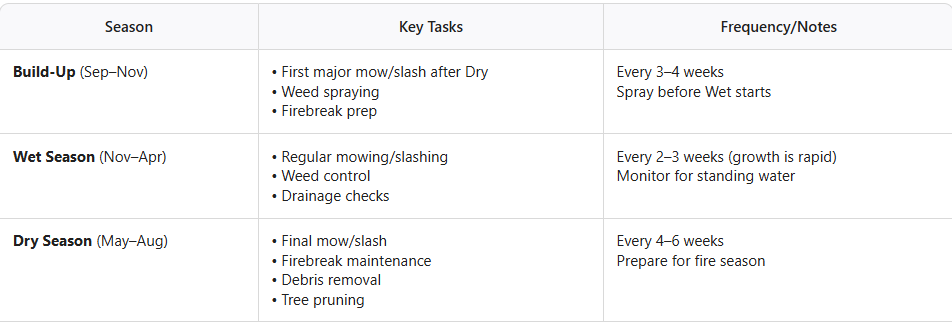
Pro Tip:
“Book your maintenance early in the Wet—slots fill fast, and waiting can mean weeks of delay and a much bigger job.”
8. Why Engage a Professional? The Value of Local Expertise
Local Knowledge Matters
We know the soils, the weeds, and the weather patterns of Darwin’s rural area.
Our team is trained to spot early signs of weed infestation, pest problems, and fire hazards.
We use the right equipment for the job—saving you time, money, and hassle.
Safety and Compliance
We’re up-to-date with NT weed and firebreak laws.
Our work is fully insured and compliant with all regulations.
We can provide documentation for council, Bushfires NT, and insurers.
Peace of Mind
Scheduled maintenance means you never have to worry about surprise inspections or emergency call-outs.
Your property stays safe, beautiful, and valuable—all year round.
Conclusion: Don’t Let Your Acreage Become a Liability
Owning acreage in Darwin’s rural belt is a privilege—but it comes with real responsibilities. The Top End’s climate, aggressive weeds, and fire risk mean that letting your property get away from you isn’t just a cosmetic issue—it’s a serious financial, legal, and safety risk.
Regular, professional maintenance is the smart, cost-effective way to protect your investment, your family, and your community. Don’t wait for a letter from the council, a snake in the shed, or a fire on your doorstep.
Summary Box
Regular maintenance saves money and stress
Neglect leads to legal, financial, and safety risks
Darwin’s climate demands proactive care
Professional help is the best investment for your acreage
For more tips, advice, or a tailored turf management plan, get in touch with Darwin’s local turf experts—your lawn will thank you!
If you’re in Darwin, Palmerston, Humpty Doo or the rural areas and looking for reliable, trusted garden & grounds maintenance services, look no further than Quality Garden Services NT.
We specialize in turf management, grounds maintenance, and garden care in Darwin and the Northern Territory.
Contact us today (0498649535) to learn more about how wetting agents can transform your lawn!
At Quality Garden Services NT, we understand how important it is to maintain a lush, healthy lawn and vibrant garden in Darwin’s unique climate.
Why Choose Us?
Choosing the right grounds maintenance and gardening service is crucial for the health and appearance of your property. Here’s why we stand out:
Local Expertise: Our team is familiar with the unique climate and soil conditions of the Darwin, Palmerston, Humpty Doo and surrounding areas. We know what works best for your gardens and lawns.
Quality Service: We are committed to delivering high-quality work. Our goal is to exceed your expectations, leaving you with well-maintained outdoor spaces.
Customer Satisfaction: Your satisfaction is our priority. We take the time to listen to your needs and tailor our services accordingly - be it for commercial or private properties.
Thank you for visiting our website!